Liquidity Is a Separate Problem From Tokenization
This is the final part of a three-part series on liquidity in tokenized real-world asset markets.
Part I examined how liquidity is measured and how automated market makers function in crypto-native markets. Part II considered why those mechanisms transfer poorly to individually valued real-world assets. It argued that RWA markets need asset-specific legal rights, credible valuation, committed quote capital and active inventory management.
Part III moves from theory to implementation. It examines Fractalized’s architecture as one approach to building those elements into a single market and sets out the measures by which such a system should be judged.
The analysis below draws on Fractalized’s public documentation and company-reported operating data. The reported results have not been independently audited for this article.
Tokenization is one layer of the market
A real-world asset market involves more than issuing a token and creating a liquidity pool.
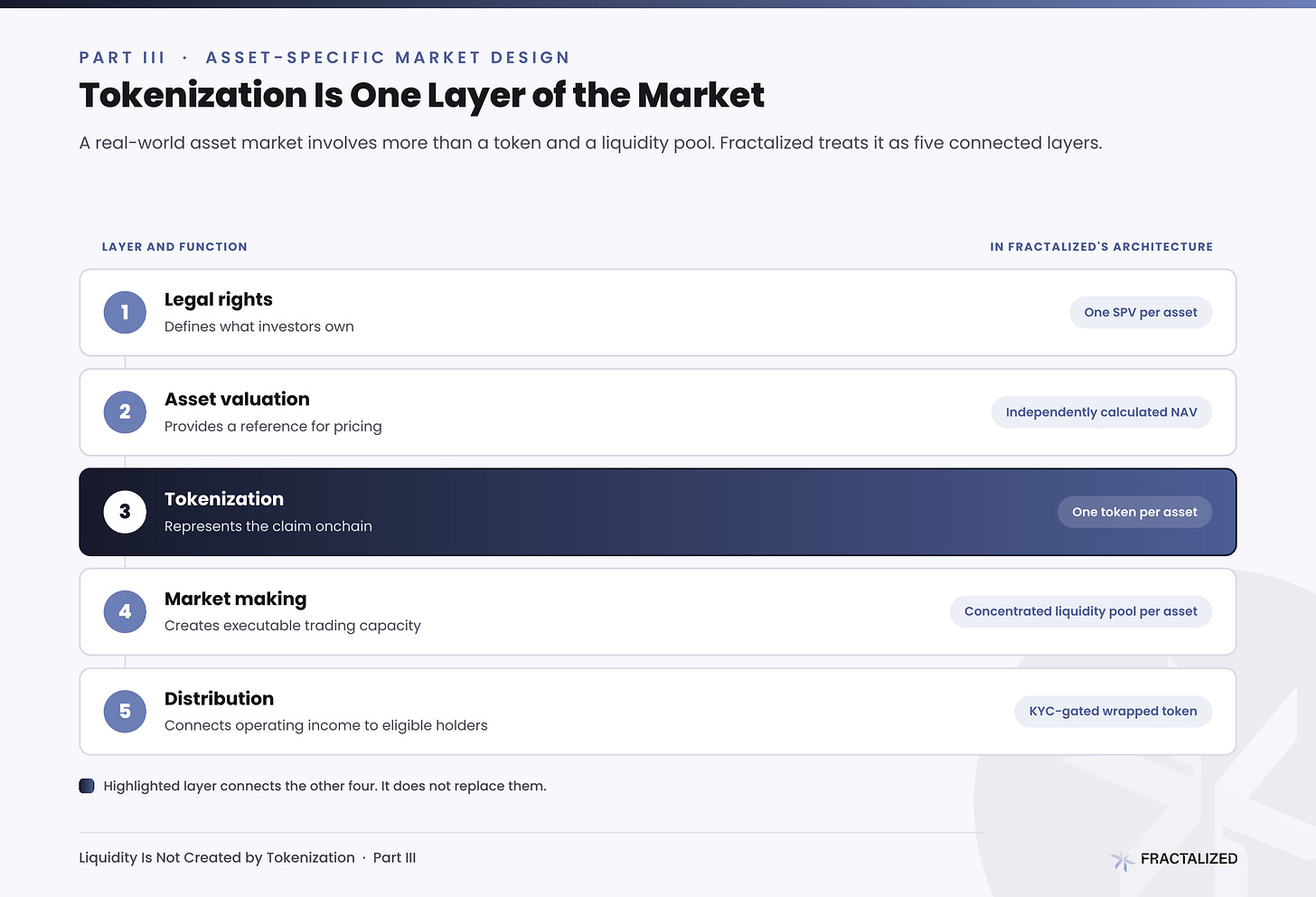
Fractalized’s architecture treats the market as five connected layers: legal rights, asset valuation, tokenization, market making and distribution. Each performs a different function.
The legal structure defines what investors own. Valuation provides a reference for pricing. Tokenization represents the claim onchain. Market making creates executable trading capacity. Distribution connects the asset’s operating income to eligible holders.
Tokenization sits between these layers. It connects them, but it cannot replace them.
A dedicated legal structure for each asset
Each admitted asset is associated with its own special-purpose vehicle.
The SPV holds the relevant asset interest, receives operating income and establishes the waterfall for expenses, fees and token-holder distributions. Token holders receive contractual rights linked to the asset’s operating income and to net proceeds following a sale or liquidation.
This creates a traceable relationship between the physical asset and the onchain instrument.
A specific operating asset sits inside a defined legal entity. That entity establishes the income rights and liabilities attached to the investment. Those rights are then represented by an asset-specific token.
Investors can therefore assess the asset, its cash flows, its debt and its residual value without relying on a general claim against a changing pool of unrelated assets.
The structure does not remove legal risk. It makes that risk easier to identify and evaluate at the level where it actually exists.
This distinction also matters from a regulatory perspective. IOSCO has emphasized that investors in tokenized financial assets must be able to understand the legal rights represented by the token, the parties responsible for those rights and the consequences of ownership and transfer. A digital representation is only useful if the underlying legal claim is clear and enforceable.
One market for each asset
Every asset has its own token, settlement pool and process of price discovery.
At launch, the asset seller provides the initial token inventory. Fractalized provides baseline quote liquidity, allowing investors to purchase fractional exposure. As distribution progresses, part of the transaction flow supports protocol-owned liquidity.
The same market can therefore serve two stages of the asset’s lifecycle.
During primary distribution, it provides a mechanism for the original owner to sell exposure. Once tokens have entered circulation, the pool becomes part of the secondary market through which existing holders can trade.
This is more coherent than treating issuance and secondary liquidity as unrelated systems. The infrastructure established during distribution becomes the foundation for ongoing trading.
It also preserves the economics of the individual asset. The liquidity supporting one vessel, loan or infrastructure project remains distinct from the capital supporting another.
Separate markets use more quote capital than a single blended pool. That is the cost of maintaining risk isolation. A weaker asset cannot automatically draw on the reserves supporting a stronger one, and losses in one market remain visible where they originated.
NAV is a reference, not a redemption promise
Trading takes place within a concentrated liquidity range built around an independently calculated net asset value.
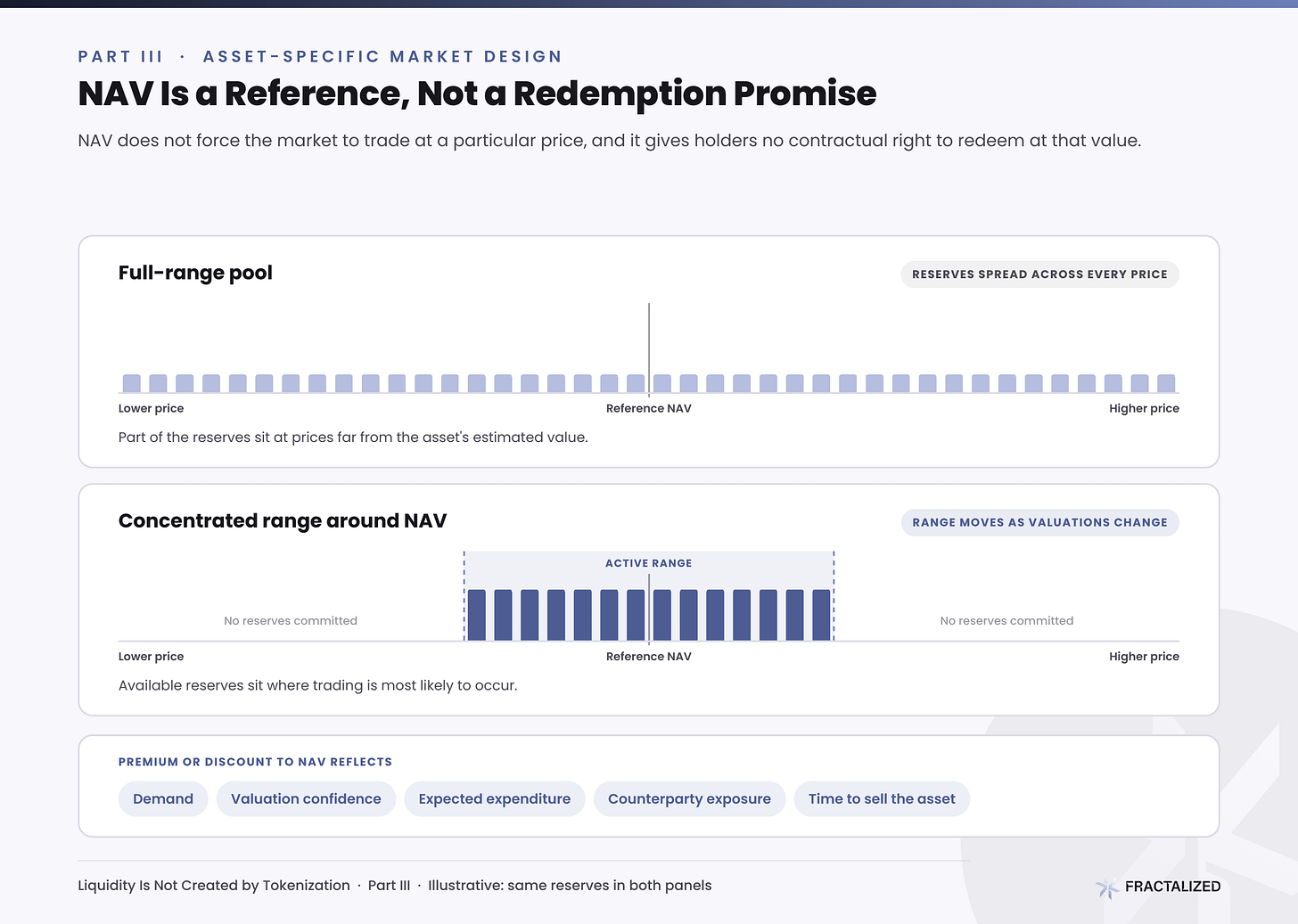
Concentrated liquidity, formalized in AMM design by Uniswap v3, allows capital to be allocated within a chosen price range rather than spread across the full curve. Fractalized applies that principle around an externally determined reference value.
This makes more sense for a unique real-world asset than an unmanaged full-range pool. Available reserves can be placed where trading is most likely to occur, rather than committed to implausible prices far from the asset’s estimated value.
The range can move as valuations change and market conditions evolve.
NAV does not force the market to trade at a particular price. Nor does it give holders a contractual right to redeem at that value.
Investors may apply a premium or discount based on demand, valuation confidence, expected expenditure, counterparty exposure or the time required to sell the underlying asset. The pool can also move away from its reference range as its token and stablecoin balances change.
NAV therefore serves as an input into active market making. It is not a hard peg.
That distinction matters because a market can be designed around a valuation without pretending that the valuation is an immediately executable sale price.
Separating trading from distribution rights
Real-world asset markets must reconcile two objectives that do not always fit neatly together.
The token needs to move efficiently through secondary markets, but receipt of the underlying income may have to remain restricted to verified and eligible investors.
Fractalized addresses this through wrapped and unwrapped token states.
The ERC-20 token acts as the liquid market representation and does not carry distribution rights. Approved holders can move into a KYC-gated wrapped state that carries the right to receive asset income. The router manages movement between the two forms.
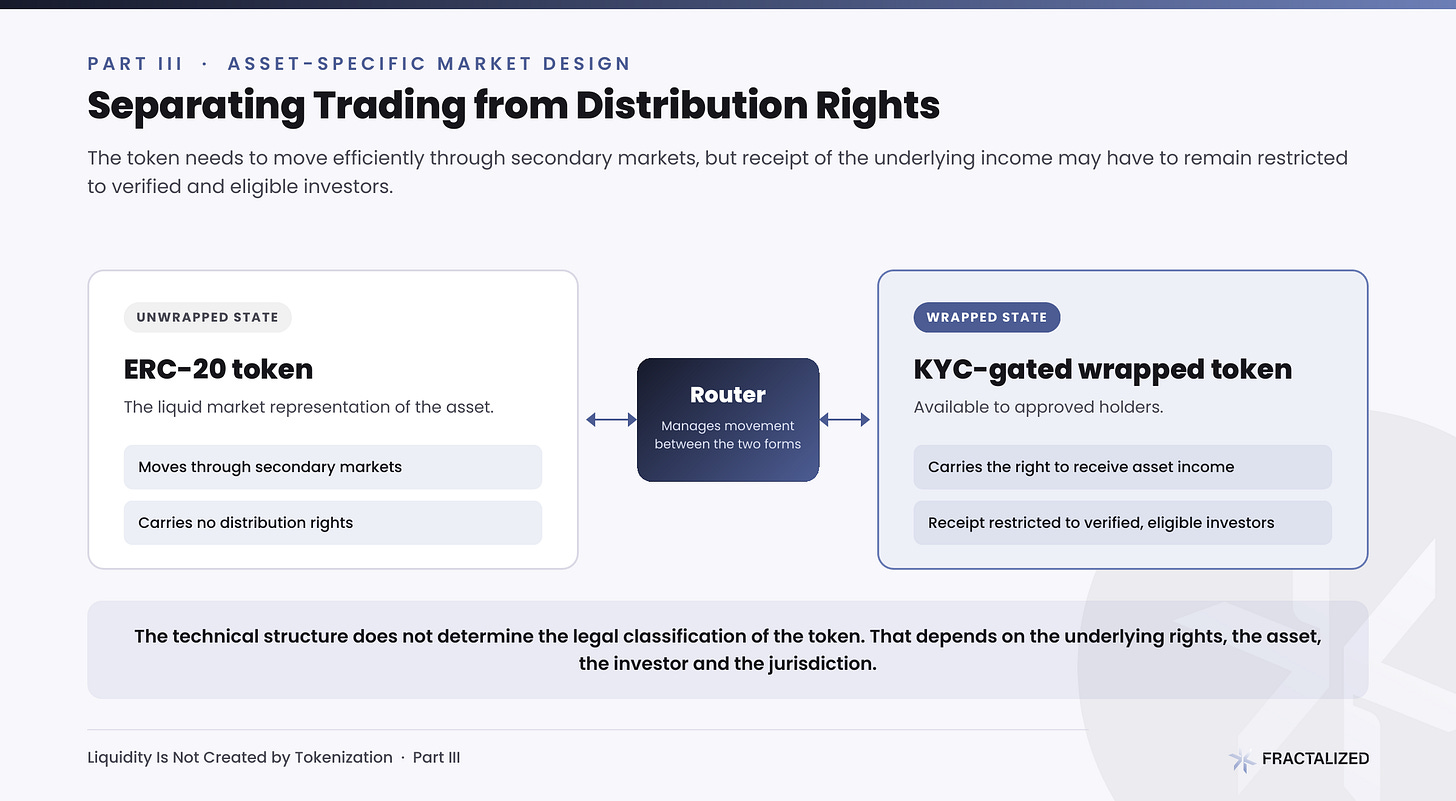
This allows secondary trading and compliance-controlled distributions to operate through the same architecture without treating them as the same function.
The technical structure does not determine the legal classification of the token. That still depends on the underlying rights, the asset, the investor and the jurisdiction involved.
What the structure provides is a practical way to enforce eligibility conditions around distributions while retaining onchain market functionality.
Shared infrastructure without blended economics
Separate asset markets improve transparency and risk isolation, but they can also fragment liquidity and create a poor user experience.
Fractalized’s router is designed to address that problem.
Each asset retains its own pool and its own price. The router coordinates execution across those pools and abstracts much of the underlying complexity from the investor.
This allows the platform to share settlement, compliance, routing and market-making infrastructure without combining the economic risks of unrelated assets.
The boundaries around shared liquidity must still be explicit.
Investors should be able to see how much capital is permanently assigned to each market, how much can be reallocated and whether losses or sustained selling in one pool can reduce the liquidity available elsewhere.
A shared router improves execution. It should not create an undisclosed guarantee between markets.
This is consistent with the broader infrastructure problem identified by the BIS and CPMI. Shared tokenized infrastructure can improve efficiency, but it requires clear governance and risk controls to prevent operational or financial dependencies from becoming opaque.
MT Tulip as a live deployment
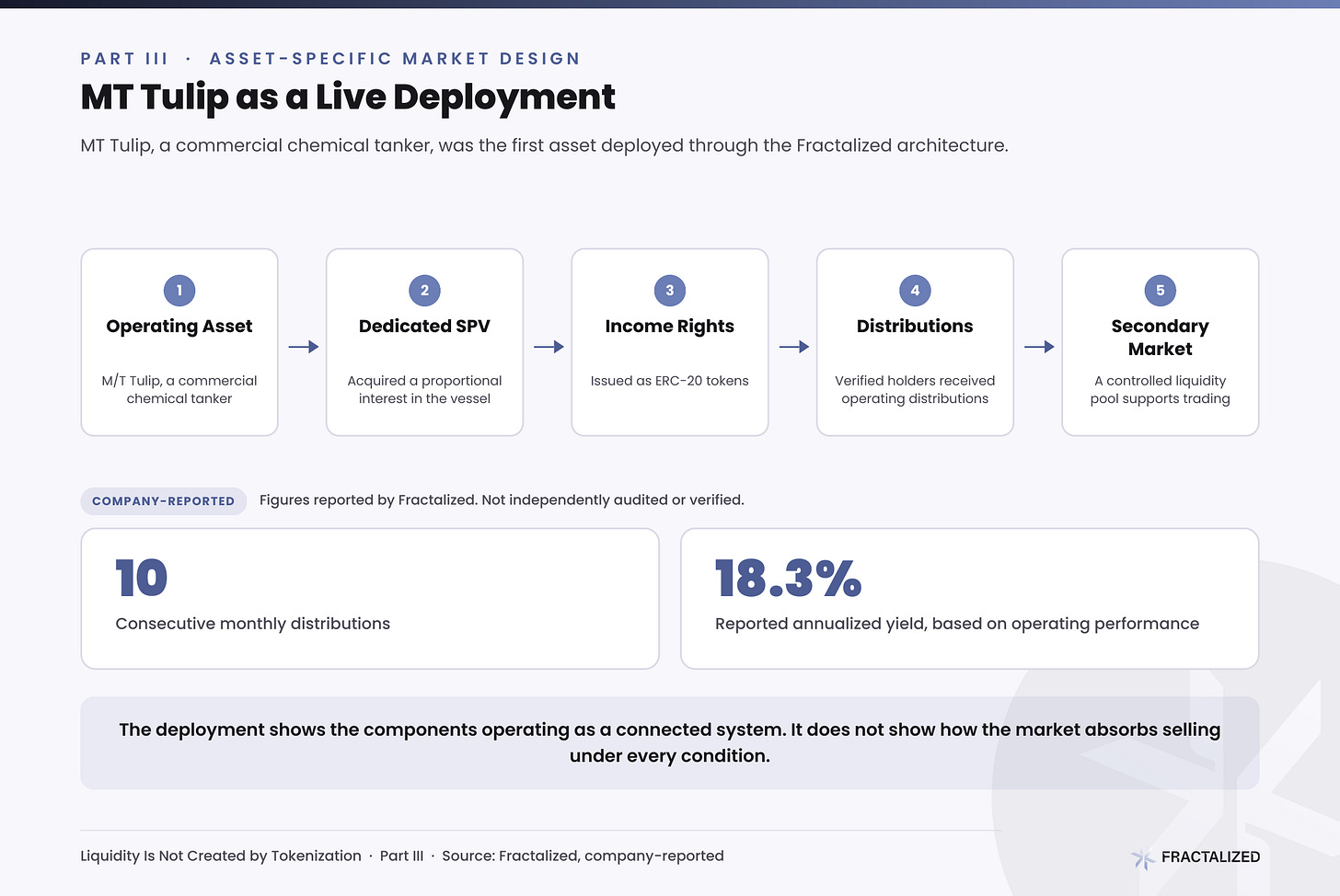
MT Tulip, a commercial chemical tanker, was the first asset deployed through the Fractalized architecture.
A dedicated SPV acquired a proportional interest in the vessel. Income rights were issued as ERC-20 tokens. Verified holders received operating distributions, while a controlled liquidity pool supported secondary trading.
As of [date], MT Tulip had completed ten consecutive monthly distributions and reported an 18.3% annualized yield based on operating performance. These figures are Fractalized’s own reporting and have not been independently verified for this article.
The significance of the deployment goes beyond the reported yield.
MT Tulip connects the full lifecycle described above: an operating physical asset, a dedicated legal structure, defined income rights, an onchain token, a distribution process and a secondary market.
That does not prove that the market can absorb selling under every condition. It shows that the individual components can operate as a connected system rather than as separate demonstrations of token issuance, yield distribution and liquidity.
The liquidity facility remains finite
A well-designed structure can reduce liquidity risk without eliminating it.
Fractalized’s risk framework states that concentrated selling can deplete protocol-owned liquidity and prevent holders from exiting at the reference value. It also states that 10% of primary issuance is permanently allocated to the pool and that the pool’s price range is actively managed near the reference value.
This is an important disclosure because it defines the pool as a finite market-making facility.
It is not an unconditional obligation to buy every token at NAV.
The pool may provide immediate execution for orders that fit within the available reserves and active price range. Larger orders, sustained selling or a material change in valuation can produce a different result.
The market should be judged by how clearly it communicates those limits and how effectively it manages them.
How the model should be measured
Architecture alone is not enough.
A platform can have well-designed contracts, asset-specific pools and professional valuation processes while still offering very little practical liquidity. The quality of the market has to be assessed through observable execution data.
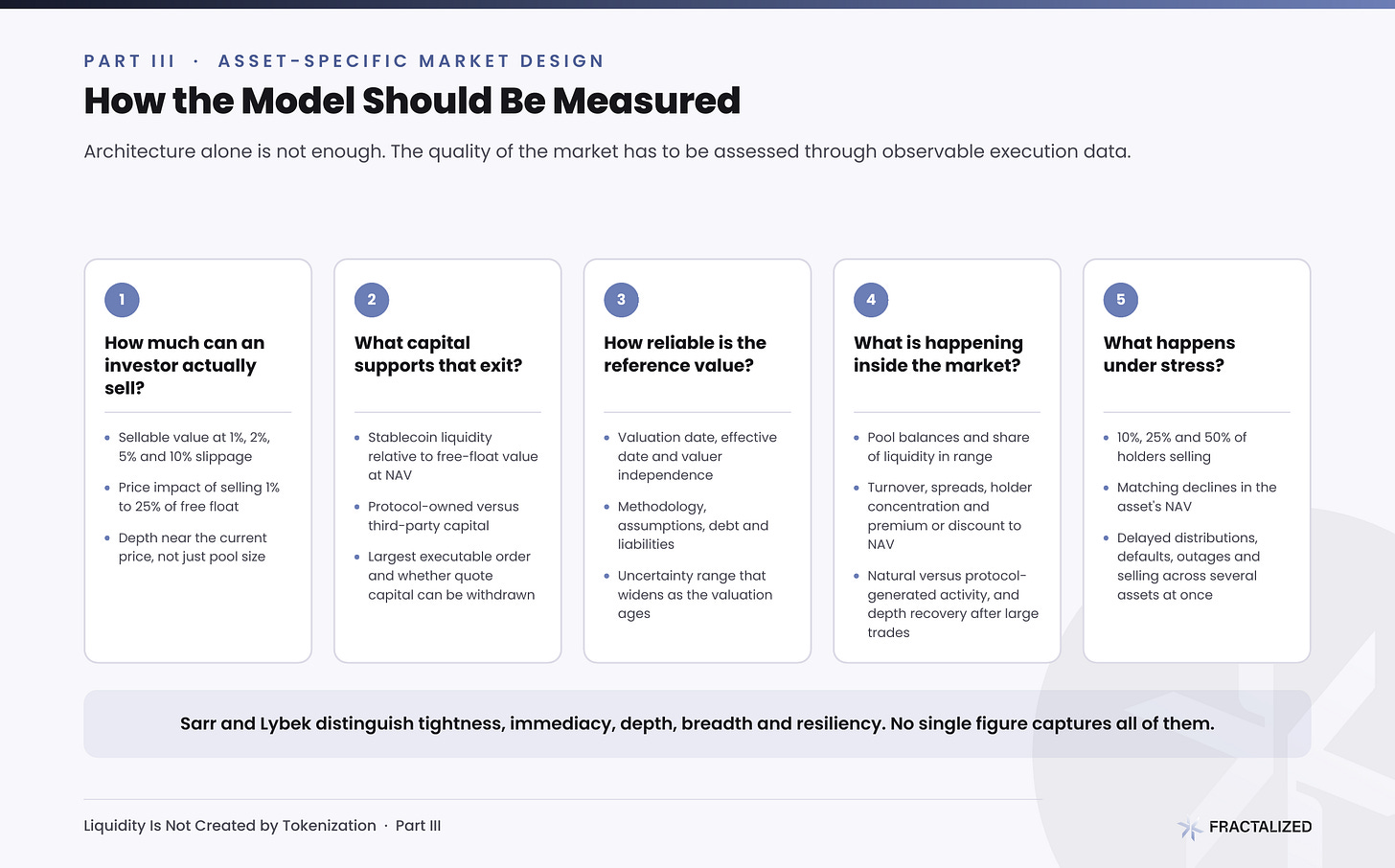
Sarr and Lybek’s framework for measuring financial-market liquidity distinguishes between tightness, immediacy, depth, breadth and resiliency. No single figure captures all of them. Total value locked, for example, says little about the price at which an investor can sell or how quickly a market recovers after a large transaction.
For an asset-specific RWA market, the most useful measures answer five questions.
How much can an investor actually sell?
Each asset market should show the token value that can currently be sold at defined levels of slippage, including 1%, 2%, 5% and 10%.
Investors should also be able to see the expected effect of selling larger portions of the available supply, such as 1%, 5%, 10% or 25% of free float.
These figures reveal the difference between liquidity displayed by the pool and liquidity that can be used at an acceptable price.
A pool may contain substantial capital while offering little depth close to the current price. Conversely, a smaller pool with concentrated liquidity may handle ordinary transactions efficiently but deteriorate quickly once an order moves beyond its active range.
What capital supports that exit?
The amount of settlement liquidity available should be compared with the market value of the circulating token supply.
One simple measure is available stablecoin liquidity divided by free-float token value at NAV. The result does not imply that all tokens can be redeemed at NAV. It shows the scale of liquid reserves relative to the supply that could potentially be sold.
The composition of those reserves matters as well.
A market dashboard should distinguish protocol-owned liquidity from third-party capital, identify how much liquidity is currently active and show the maximum order that can be executed under prevailing conditions.
It should also disclose whether quote capital is permanently assigned to the market or can be withdrawn, reallocated or used elsewhere.
How reliable is the reference value?
Investors need more than a published NAV.
They should be able to see when the valuation was completed, when it became effective, who produced it and whether the valuer is independent. The methodology, material assumptions, debt, liabilities and accrued but unpaid income should also be visible.
A credible valuation process should acknowledge uncertainty rather than presenting a single number as exact.
The uncertainty range should widen as the valuation ages or when an event changes the asset’s operating outlook. Any material development after the valuation date should be disclosed alongside the reference value.
The appraisal should also be distinguished from an executable bid. A vessel valued at $15 million is not necessarily saleable for $15 million today, particularly once transaction costs, legal transfer requirements and the time needed to find a buyer are considered.
What is happening inside the market?
Pool condition should be visible in real time.
Useful information includes the current token and stablecoin balances, the percentage of concentrated liquidity that remains in range, the distance to the next range boundary and the market maker’s inventory outside the pool.
Market quality should be assessed separately from pool size.
Relevant measures include daily and monthly turnover, active buyers and sellers, holder concentration, median holding period, prevailing spreads and the token’s premium or discount to NAV.
Platforms should also distinguish natural investor activity from transactions generated by the protocol or its market-making operations. A large volume figure means little if most activity does not reflect independent buying and selling.
The speed with which depth returns after a large trade is another important signal. A market that can absorb one transaction but remains depleted for weeks is less liquid than its initial execution might suggest.
What happens under stress?
The system should be tested against conditions that exceed normal daily trading.
Those tests should include 10%, 25% and 50% of circulating holders attempting to sell, as well as equivalent declines in the underlying asset’s NAV.
Operational scenarios matter too. A distribution may be delayed. A charterer or borrower may default. The asset may temporarily stop operating. The settlement stablecoin or underlying network may face disruption.
Stress testing should also consider simultaneous pressure across several assets. A shared router or liquidity facility that works for one isolated market may behave very differently when sellers appear across the platform at the same time.
These scenarios establish whether the system contains genuine market-making capacity or merely the appearance of continuous liquidity.
Instant settlement has limits
Onchain execution can settle within seconds.
A token enters the smart contract, the pool calculates the available output and the settlement asset reaches the trader’s wallet. That experience is materially faster than most traditional private-market transfers.
The transaction still depends on the state of the market at that moment.
The pool must have enough settlement liquidity. The order must remain within an active range. The investor must accept the quoted price and resulting slippage. Compliance requirements must be satisfied, and neither the market nor the underlying contracts can be paused following a material event.
Immediate settlement and unlimited exit are therefore different claims.
The Financial Stability Board has warned that tokenization can create a liquidity mismatch when a token appears more readily tradable than the asset supporting it. The ability to submit a transaction at any time does not mean the market can absorb that transaction at NAV.
A well-designed RWA market should not promise that every investor can always sell at the reference value. It should show investors how much they can sell now, the price available for that order, the reserves supporting it and the conditions under which execution may change.
That is a more useful and defensible definition of liquidity.
Conclusion
Private-market assets are illiquid for reasons that exist independently of their settlement technology.
Their values are uncertain, legal transfers can be complex, due diligence is costly and natural buyer pools are often limited. Many positions cannot be hedged, while selling the underlying asset may take weeks or months.
Tokenization can reduce several of these frictions. It can divide ownership into smaller units, improve record-keeping, automate distributions, embed transfer rules and shorten settlement.
The IMF describes tokenization as capable of supporting atomic settlement, continuous liquidity management and embedded compliance. It also emphasizes that these benefits depend on legal certainty, reliable settlement assets, sound governance and effective risk management.
Tokenization cannot make a physical asset immediately saleable at its estimated value.
That is why RWA liquidity requires more than the passive market mechanisms developed for widely traded crypto assets. Programmable settlement has to be combined with independent valuation, enforceable legal rights, professional quote capital, active inventory management and defined controls for periods of uncertainty.
Fractalized’s architecture follows that logic at the asset level: one asset, one SPV, one token, one valuation process and one liquidity pool. Routing, compliance, settlement and market-making infrastructure can be shared above those markets without blending their underlying economic risks.
An individual pool does not guarantee liquidity. It makes liquidity visible, attributable and manageable where the risk originates.
Tokenization can make an asset easier to hold and transfer. Liquidity still depends on whether someone is prepared, and sufficiently capitalized, to make a market in it.
Bibliography
Fractalized primary sources
Fractalized. “Whitepaper: Offchain Economies. Onchain Accessibility.” Last updated 17 September 2026. Accessed 12 October 2026. The whitepaper describes the asset-specific SPV model, token-holder income rights, wrapped and unwrapped token architecture, individual liquidity pools, NAV-based market design, routing system, risk framework and MT Tulip deployment.
Fractalized. “Tulip Case Study: Tokenizing a Live Commercial Vessel.” 2 March 2026. Accessed 12 October 2026. The case study documents the MT Tulip deployment, including the dedicated SPV, ERC-20 issuance, controlled secondary-liquidity pool and initial operating-income distribution.
Fractalized. “Connecting Prime Real-World Assets to Onchain Capital Markets.” Accessed 12 October 2026. Used for current platform terminology, including monthly USDT distributions and the live status of MT Tulip.
Independent sources
Adams, Hayden, Noah Zinsmeister, Moody Salem, River Keefer and Dan Robinson. “Uniswap v3 Core.” March 2021. Accessed 12 October 2026. Used for the mechanics of concentrated liquidity and the allocation of liquidity-provider capital within defined price ranges.
Adrian, Tobias. “Tokenized Finance.” IMF Note 2026/001. International Monetary Fund, April 2026. Used for the discussion of atomic settlement, continuous liquidity management, embedded compliance, legal certainty, governance and reliable settlement assets.
Bank for International Settlements and Committee on Payments and Market Infrastructures. “Tokenisation in the Context of Money and Other Assets: Concepts and Implications for Central Banks.” Report to the G20, October 2024. Used for the analysis of programmable financial infrastructure, shared platforms, governance, interoperability and risk management.
Financial Stability Board. “The Financial Stability Implications of Tokenisation.” 22 October 2024. Used for the discussion of liquidity mismatch, asset-price uncertainty, interconnectedness and operational fragilities in tokenized markets.
International Organization of Securities Commissions. “Tokenization of Financial Assets: Final Report.” FR/17/25, November 2025. Used for the discussion of legal uncertainty, investor understanding of token-holder rights, market integrity and the risks arising from DLT-based financial infrastructure.
Sarr, Abdourahmane, and Tonny Lybek. “Measuring Liquidity in Financial Markets.” IMF Working Paper 02/232. International Monetary Fund, December 2002. Used for the liquidity-measurement framework covering tightness, immediacy, depth, breadth, turnover, price impact and resiliency.
Fractalized Blog & Industry News
Stay up to date with the latest news from Fractalized: product updates, asset insights, news from the real-world asset and tokenization space.

ready when you are.
Whether you operate cash flow assets, build financial products, or allocate capital, the platform is live and the team is reachable.
Contact
Follow us